Statistics

Quantum of Marketing Spend vs Pattern of Marketing Spend

Quantum of Marketing Spend vs Pattern of Marketing Spend

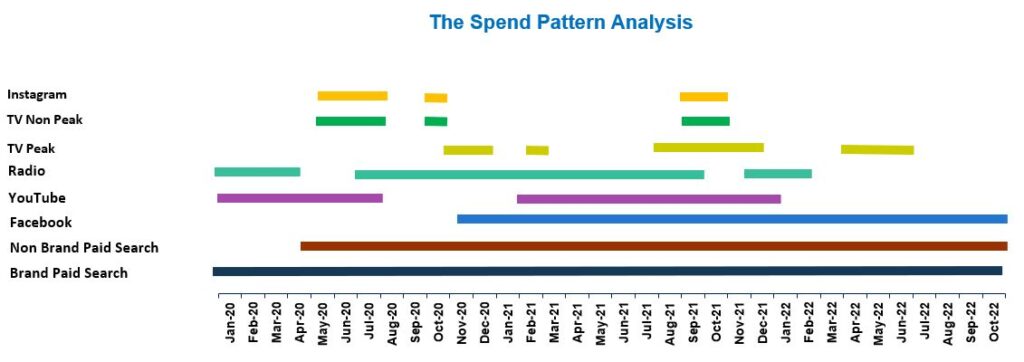
In every Marketing Mix Modeling (MMM) project that we undertake, we always study the previous spend pattern of the client. Why? Because how much one spends in marketing channels gives us only partial information. The other half is about the spend pattern in those channels. A brand with a ‘single burst’ strategy may not be […]

Quantum of Marketing Spend vs Pattern of Marketing Spend Read More »

Do you use the right tools to evaluate your MMM model?

Do you use the right tools to evaluate your MMM model?

Do you use the right tools to evaluate your MMM model? Having the right tools to measure your MMM model’s accuracy is as important as specifying the model correctly. Contrary to popular belief, MMM is just not about retrodiction. If the model is well specified, it can also be used for forecasting (for a reasonable

Do you use the right tools to evaluate your MMM model? Read More »

Using Transfer Entropy for Feature Selection in MMM

Using Transfer Entropy for Feature Selection in MMM

Few months back we published our whitepaper ‘Granger Causality – A possible Feature Selection Method in MMM’. ICYMI the link is in the resources section. In this blog I want to highlight another useful feature selection method – Transfer Entropy. As you must have guessed, the method is a information theoretic method. In case you

Using Transfer Entropy for Feature Selection in MMM Read More »

Why Decomp RSSD is a Business Fit Metric

Decomp RSSD – The business fit calibration During the Meta panel discussion (link in Resources section), I had mentioned about Robyn’s Decomp RSSD metric. In our earlier posts too, both my co-founder Venkat and I extensively covered the topic of calibration and validation extensively. Calibration of MMM model can be achieved through goodness of fit.

Why Decomp RSSD is a Business Fit Metric Read More »

How to use AIC to select the best Marketing Mix Model (MMM).

How to use AIC to select the best Marketing Mix Model (MMM).

How to use AIC to select the best Marketing Mix Model (MMM). Firstly, let’s look at what is AIC and the most common misunderstanding associated with it. The Akaike information criterion (AIC) is given by: AIC = 2k -2ln(L) where k is the number of parameters L is the likelihood The underlying principle behind usage

How to use AIC to select the best Marketing Mix Model (MMM). Read More »

How understanding seasonality and cyclicity can help you build better MMM models

How understanding seasonality and cyclicity can help you build better MMM models

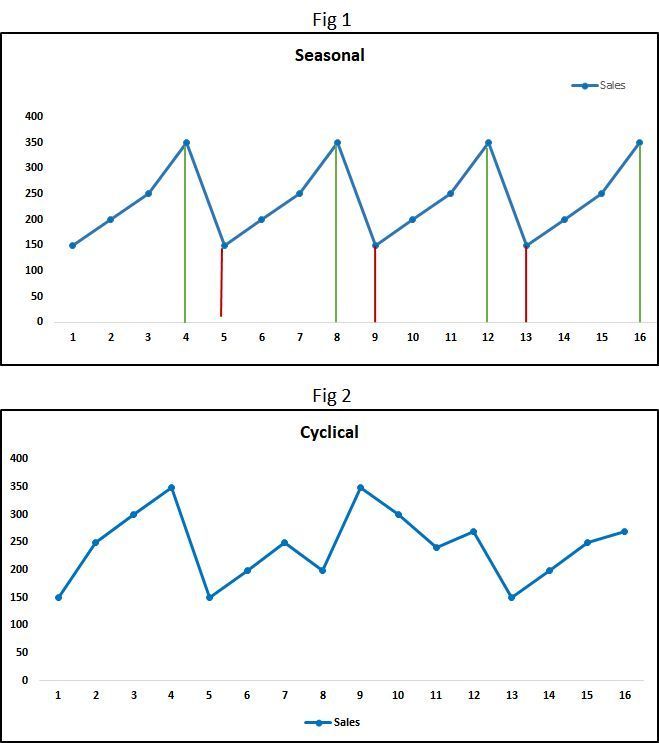
Seasonality ≠ Cyclicity Be it time series analysis or Marketing Mix Models (MMM), the distinction between seasonality and cyclicity is important. Many confuse seasonality with cyclical time series. Here is a quick distinction. Seasonal: A seasonal pattern is a fluctuation which occurs at regular time intervals. These time intervals are predictable. Seasonality does not always

How understanding seasonality and cyclicity can help you build better MMM models Read More »

Standardization before Regularization in MMM

Standardization before Regularization in MMM

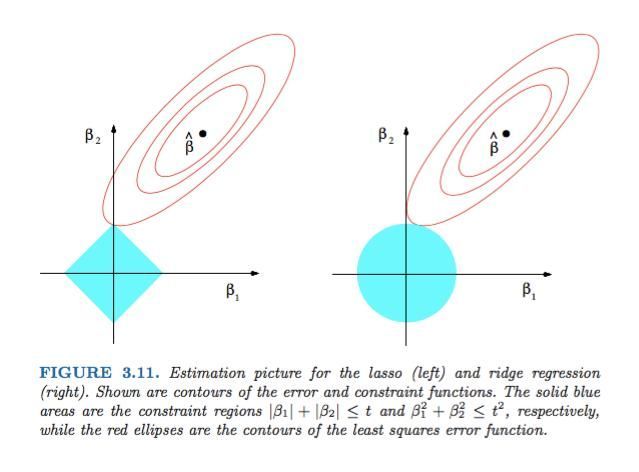
Standardization before Regularization in MMM In my last post (link under resources), I covered the topics of Multicollinearity and Endogeneity. And how solving for Multicollinearity can lead to Endogeneity. To solve for Multicollinearity, many adopt regularization like Lasso or Ridge. But here are some key points to keep in mind. 👉 L1 and L2 are the

Standardization before Regularization in MMM Read More »

How common are S-curves in Marketing Mix Models (MMM)?

How common are S-curves in Marketing Mix Models (MMM)?

How common are S-curves in Marketing Mix Models (MMM)? Before we dwell on the S-curves, let’s talk about the Hill function. Did you know that the Hill function used for transforming media variables to capture diminishing effect has its origins in Biochemistry and pharmacology!! The equation was formulated by Archibald Hill in 1910 to describe

How common are S-curves in Marketing Mix Models (MMM)? Read More »

Multicollinearity is one of the enemies of Marketing Mix Modeling (MMM).

Multicollinearity is one of the enemies of Marketing Mix Modeling (MMM).

Multicollinearity is one of the enemies of Marketing Mix Modeling (MMM). Multicollinearity generally occurs when there is a high correlation between independent variables. Multicollinearity does not affect predictive power of the model but it causes a lot of issues when one needs to infer or attribute the changes in dependent variable to the independent variables.

Multicollinearity is one of the enemies of Marketing Mix Modeling (MMM). Read More »

Scroll to Top